The format of the debates
The format of Intelligence Squared debates is to have four people invited to speak for
the motion (the "defenders" team) and against the motion (the "opposers" team), respectively.
Everything is overseen by an efficient moderator.
The speakers for Atheism is the new fundamentalism were:
- in the defenders' team:
- Richard Harries – retired bishop of the Church of England and the 41st Bishop of Oxford (1987-2006)
- Charles Moore – journalist and former editor of the Daily Telegraph
- in the opposers' team:
- A. C. Grayling – philosopher, writer and professor of philosophy; also a Fellow of the Royal Society
of Literature and the Royal Society of Arts
- Richard Dawkins (no presentation should be required...)
The debate itself is comprised of two parts:
- the pleading, in which all the speakers state their case;
- the questions and answers session, in which questions from the audience are answered by
the speakers.
The full debate
The full Atheism is the new fundamentalism debate is embedded below:
However, it is over one and a half hours, so if you do not have the time to watch it
right now, just read on to find out where the leprechaun kicks in.
The part of the debate that I am referring to in this article starts in the video
embedded above at time 48:35 and lasts just a few minutes. (In-video navigation should be
pretty fast, you can try it.)
The 'outrageous' episode
During the questions and answers session, Charles Moore stated:
Did you notice the atheist bus campaign that they had? On the side, it said:
'There's probably no God.'
And the reason they said that, I think, is that they realized they were in a bit of a
muddle about this, because they could only truthfully say according to their own
position that there probably is no God, because if they said, 'There is no God.',
they would be making a statement of faith, and of course they feel they mustn't do that.
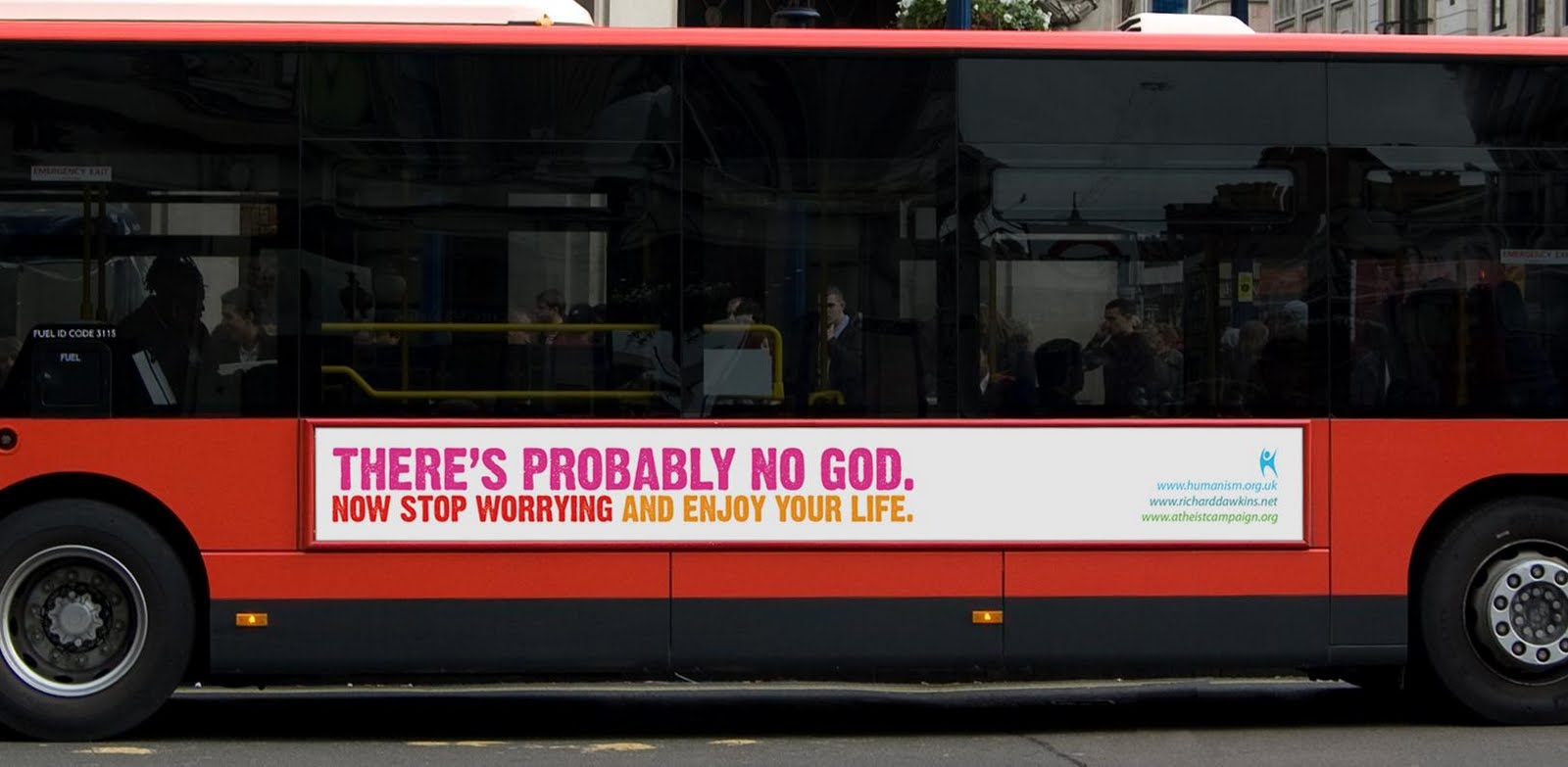
Atheist bus campaign
What is hilarious about this fragment is that each time I re-read or re-listen to it,
I get the distinct feeling that Charles Moore intended to make it come off as an accusation.
He did not seem to realize the fact that the arrogance of "knowing it all" is an
exhibition of most believers (who just know or feel it in their gut that it is so)
and not of atheists.
Atheism simply lacks the omniscience arrogance.
So Mr. Moore, beside completely having missed the point, actually helped Richard Dawkins,
who promptly answered:
What could be more fundamentalist than saying, 'There definitely is no God'? We
demonstrated our lack of fundamentalism by saying the proper scientific thing – 'There's
probably no God'.
The audience applauded and then the moderator asked:
So, Richard, does that mean that there may be a God, logically?
to which Professor Dawkins readily replied:
There may be a... leprechaun.

There may be a leprechaun
On leprechauns and reality
Indeed, why wouldn't there be a leprechaun? It is just as likely as the existence of any other
supernatural being, claimed on faith grounds, with no evidence presented whatsoever.
Just so you know: mass delusion and hallucination do not count as evidence.
Since every religion assumes the existence of another 'realm' that does not fall within the
control or influence of the world as we know it, it can virtually postulate just about anything. It is
not the job of the physical laws of the perceptible and measurable realm to prove or disprove the
truth of claims pertaining to spoken-into-being strata of 'reality'.
Therefore, being given that the "other realm" fails to accept any means of measurement, observation
and investigation, science and philosophy cannot fully dismiss it as false. There is a remote
possibility that a leprechaun, a Thor, a Zeus, a God, an Allah, a Pink Unicorn or a Flying
Spaghetti Monster exist somewhere in those intangible strata.
It logically follows that we should be agnostic in regards to the existence of those beings, since
we cannot scientifically disprove them. For all
practical purposes though, we are a-thorists, a-pink-unicornists and so on.
Just as christians are, for practical purposes, atheists in regards to the "ridiculous" idea of
leprechauns, Thor, Zeus, the Pink Unicorn, the Flying Spaghetti Monster and Allah, we take the "a-"
thing one god further.


 Posts
Posts


